
Copy of How Do You Know When Your Business Is Ready to Scale?
Growing your business and being ready to scale are not always the same thing. Before taking on more clients, revenue,


A business can only move as quickly as the person or process it is waiting on. For many growing companies, that person is the founder.
It is easy to miss this because founder involvement often looks like commitment. You are reviewing proposals, answering questions, approving expenses, checking client work, joining sales calls, making marketing decisions, solving team problems, and stepping in whenever something feels unclear.
At first, that level of involvement can be necessary. You built the business, so naturally, you know the customers, the offer, the standards, and the reasons behind many of the decisions being made.
The problem begins when the business continues to depend on you in the same way after it has grown.
At that point, your involvement is no longer simply leadership. It has become a constraint on the organization. That is what a founder bottleneck is.
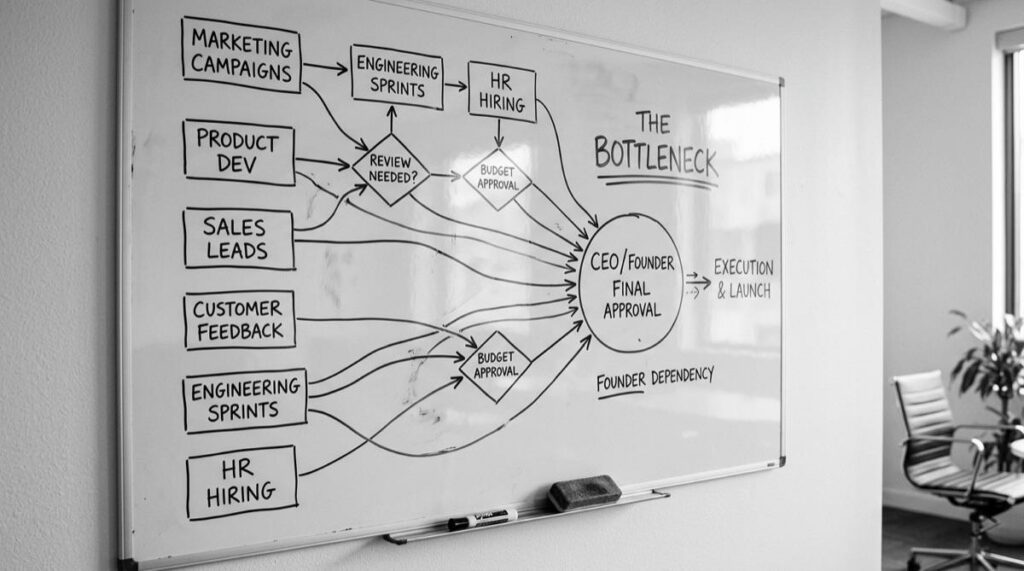
A founder bottleneck occurs when too many decisions, approvals, responsibilities, or processes depend on the founder before the business can move forward.
The bottleneck does not always look dramatic.
Sometimes it looks like a team waiting three days for an approval that takes the founder five minutes.
Sometimes it looks like employees repeatedly asking the same questions because the answer exists only in the founder’s head.
Sometimes it looks like a founder reviewing work that someone else is fully capable of reviewing.
It can also appear in less obvious ways. A founder may continue to handle the most important sales conversations, make final marketing decisions, approve client deliverables, resolve internal conflicts, and maintain key relationships because they believe they are protecting the quality of the business.
The intention may be good. The structure is still creating dependency. A useful question is:
What would stop moving if I stepped away from the business for two weeks?
Your answer can reveal more about your operational structure than your organizational chart can.
Think of the founder as the only bridge connecting two sides of a growing city.
When the city is small, a single bridge works. A few cars cross at a time, traffic moves, and nobody thinks much about it. But then the city grows.
More people move in. More businesses open. More deliveries need to get across. Suddenly, thousands of cars are trying to use the same bridge every day.
The problem is not that the bridge became worse. The problem is that the city outgrew the bridge.
That is what happens in a growing business when the founder remains the central point for every decision, approval, relationship, and problem.
Founder dependency is usually not created because a founder deliberately wants to control everything. It often develops because the founder was the person who initially had to do everything.
In the beginning, that makes perfect sense. When you have three clients, a small team, and a handful of decisions to make each day, you can be the bridge. You can make the decision, communicate it, and move on.
But as the business grows, the traffic increases.
What worked with three clients may not work with thirty. What worked with a small team may become inefficient when you have multiple departments or contractors. What was once a reasonable quality-control process can eventually become a queue of approvals sitting in your inbox.
At some point, telling the founder to simply “work faster” is the wrong solution. You need more bridges.
In business, those bridges are systems, clear ownership, decision-making authority, documented processes, and capable people who can move work forward without waiting for the founder.
This creates an important transition point in business growth: the founder has to stop being the primary mechanism through which the business operates.
That does not mean becoming uninvolved. It means becoming involved at the right level.
The founder’s role should evolve from being the bridge that everything has to cross into being the person designing where the bridges need to go.

There is an important distinction between leadership and operational dependency.
Leadership provides direction, establishes priorities, allocates resources, develops people, protects the company’s standards, and makes decisions that genuinely require executive judgment.
A bottleneck occurs when the founder is routinely making decisions that could reasonably be made elsewhere. For example, consider these two situations.
Scenario 1, a founder decides which market the company should enter next after reviewing financial projections, customer demand, operational capacity, and strategic priorities. That is leadership.
Scenario 2, a founder has to approve every social media graphic before it is published because the team is unsure what the founder considers acceptable. That is a systems problem.
The solution is not simply to tell the founder to “let go.”
The business needs to make the decision-making process clearer.
Before trying to fix the problem, identify where the dependency actually exists.
Start by looking at the last two weeks of your calendar, inbox, messages, and internal communications.
Ask yourself:
That last question matters. Founders often hold onto responsibilities that made sense at an earlier stage of the business but no longer make sense at the current stage.
Your business has changed. Your role needs to change with it.

Delegation is NOT the goal. That distinction is important because indiscriminate delegation can create a different kind of operational problem.
There are responsibilities that should remain with the founder or executive team.
These might include major strategic decisions, company vision, key financial decisions, critical partnerships, significant hiring decisions, or relationships where the founder’s involvement is genuinely part of the value proposition.
The question is not: “How can I get everything off my plate?”
A better question is “Which decisions genuinely require me, and which decisions require a system?”
That shift changes the conversation from delegation to organizational design.
One of the most common mistakes in delegation is assigning a task without giving the person enough authority to actually own it.
For example, you might tell someone, “Please manage our client onboarding.” On the surface, that sounds like a clear delegation of responsibility. However, several important questions remain.
Can that person change the onboarding sequence if they see a better way to serve the client? Can they update the client communications when something is unclear? Can they resolve a minor client issue without coming back to the founder for approval? Can they make a reasonable purchase to solve an onboarding problem? Can they improve the process when they identify an inefficiency?
If the answer to each of those questions is still, “Ask the founder first,” then the responsibility has not really been delegated.
The task has moved, but the bottleneck has not.
Effective delegation requires clarity around both responsibility and decision rights. The person responsible for the work needs to understand what they own, what they are authorized to decide independently, which situations require escalation, and what outcomes they are accountable for delivering.
That is how you begin building real operational autonomy.
If your team repeatedly asks you the same question, that question probably belongs in a system.
This does not mean creating a 40-page operations manual for every function of the company. Start with the decisions that happen frequently.
For example, you might document how the team should respond when a client requests a revision outside the agreed scope, what qualifies as a qualified sales lead, what requires executive approval before a proposal is sent, how to handle a dissatisfied client, which expenses team members can approve independently, and what information must be collected before a project begins.
Document the answer once. Then give the person responsible enough authority to apply it.
Over time, this creates something much more valuable than a collection of procedures. It creates organizational memory.
The company becomes less dependent on what the founder happens to remember.
A team does not need to bring every problem to leadership. However, they do need to understand which problems should be escalated.
A practical escalation framework can divide decisions into three categories.
This simple distinction can eliminate a surprising amount of unnecessary back-and-forth. It also gives employees something many organizations fail to provide: confidence about the boundaries of their authority.

Once responsibilities begin moving away from the founder, establish a small number of meaningful measures.
The purpose is not to monitor every action. It is to know whether the system is producing the expected result.
For example, instead of reviewing every client deliverable, you might track client satisfaction, revision rates, delivery times, or other indicators that tell you whether the process is working.
Instead of personally checking every sales activity, you might review pipeline health, conversion rates, revenue, and sales cycle length.
This allows the founder to move from checking the work to checking the system. That is a significant operational shift.
Fixing a founder bottleneck does not mean you will never have to step back into the details again.
Businesses change. A new offer may require decisions that have never been made before. A key employee may leave. You may enter a new market, take on a different type of client, or reach a stage of growth where your existing processes no longer make sense.
When that happens, it is normal for more decisions to come back to the founder for a while.
The important part is to figure out why they are coming back.
Think of it like a road that has suddenly developed a detour. If everyone has to come back to you because they do not know which way to go, the answer is not for you to stand in the middle of the road and direct traffic forever. You need to understand why the route is unclear and fix the road.
Every few months, look at what has started landing on your desk again and ask yourself:
“Why does this need me?”
Maybe someone needs more training. Maybe a responsibility was never clearly assigned. Maybe the team does not have enough authority to make the decision. Maybe the process needs to be updated. Or perhaps it is genuinely something that should stay with you.
The point is not to push every decision away from the founder. The point is to make sure the right decisions are reaching the right people.
There is a misconception that a successful business is one where the founder can disappear completely. That is not necessarily the goal.
The goal is to build a company where the founder’s time is spent on the areas where their judgment, relationships, vision, and leadership create the greatest value.
A founder should not have to spend their best thinking hours answering questions that the organization could answer itself.
When the operational foundation is strong, the founder can spend more time on strategy, relationships, innovation, business development, leadership, and the future of the company.
That is not stepping away from the business. It is stepping into the role the business now requires.

If too many decisions, approvals, and problems still end up on your desk, it may be time to look at what is creating that dependency.
Holly can help you step back, look at how your business is currently operating, and identify where your systems, roles, and processes may be holding back growth.
Schedule a Changemaker Strategy Call with Holly →
Let’s look at what is working, what is creating friction, and what needs to change so your business can keep moving without everything having to go through you.
Growing your business and being ready to scale are not always the same thing. Before taking on more clients, revenue,

Growing your business and being ready to scale are not always the same thing. Before taking on more clients, revenue,

Learn five practical leadership rituals that help executives stay focused, resilient, and effective during periods of market uncertainty and rapid



Leadership performance during market shifts is one of the greatest challenges facing today’s business leaders. Economic uncertainty, rapid technological advancement, changing consumer behavior, and increasing competition have created an environment where leaders must make critical decisions with less certainty than ever before.
Many executives believe that navigating uncertainty requires working longer hours, consuming more information, and responding more quickly to every challenge. In reality, the opposite is often true. Sustainable leadership performance during market shifts depends on protecting your mental clarity, preserving your energy, and creating systems that support better decision-making.
The leaders who thrive during periods of volatility are not necessarily the busiest people in the room. They are the individuals who have developed intentional habits that allow them to remain focused, resilient, and aligned with their long-term vision despite external disruption.
The following five leadership rituals can help strengthen leadership performance during market shifts while reducing burnout and improving strategic effectiveness.

1. Improving Leadership Performance During Market Shifts Through Cognitive Load Audits
One of the greatest threats to effective leadership is not a lack of information. It is having too much of it.
Most leaders begin their day with a flood of emails, messages, notifications, industry updates, news articles, and requests from their teams. By lunchtime, they have already made dozens of decisions and shifted their attention countless times. While each interruption may seem minor on its own, the cumulative effect can be significant.
Research consistently shows that decision quality declines when our mental resources become depleted. As cognitive load increases, leaders become more reactive, less creative, and more likely to rely on short-term thinking.
The challenge is not simply managing time. The challenge is managing attention.
Many leaders are unaware of how much mental energy is being consumed by activities that produce little value.
Energy leaks often appear in the form of unnecessary meetings, excessive notifications, redundant reporting, constant context switching, and an unhealthy habit of checking information that does not directly contribute to strategic decision-making.
Consider how often you review data that does not influence your actions. Think about the meetings that could have been handled through a brief update. Reflect on how frequently your focus is interrupted by information that feels urgent but ultimately changes nothing.
These small drains can quietly erode your effectiveness over time.
Set aside thirty minutes each week to evaluate how your attention has been spent. Ask yourself:
This simple exercise helps leaders reclaim valuable cognitive bandwidth and redirect it toward strategic thinking, innovation, and relationship building.
The goal is not to know everything. The goal is to focus on the things that truly matter.

Many leaders spend their days responding to other people’s priorities.
Emails arrive. Problems emerge. Questions demand answers. Notifications appear. Before long, the day becomes a series of reactions rather than intentional actions.
While responsiveness is an important leadership skill, constant reactivity prevents leaders from doing their most important work. Strategic planning, creative problem-solving, and long-term vision require uninterrupted thought.
Unfortunately, those activities are often the first to disappear when schedules become crowded.The most effective leaders understand that their best thinking rarely happens in the middle of a chaotic day.
For this reason, many high performers protect the first portion of their morning from distractions. Rather than immediately diving into emails or social media, they dedicate this time to activities that move the organization forward.
This may include strategic planning, writing, problem-solving, reviewing priorities, or developing new initiatives.
The goal is to begin the day by focusing on what is important rather than what appears urgent.
Creating focus blocks requires intentional boundaries.
Consider scheduling ninety minutes each day for uninterrupted work. Silence notifications. Close unnecessary applications. Communicate expectations with your team. Treat this time with the same respect you would give an important client meeting.
Over time, these focus blocks become a powerful competitive advantage.
While others remain trapped in reactive cycles, you create space for thoughtful leadership and meaningful progress.

Periods of uncertainty have a way of exposing our fears.
When markets shift or industries change, leaders often feel pressure to act quickly. In some cases, this pressure leads organizations to abandon proven strategies, chase trends, or pursue opportunities that do not align with their mission.
Fear can create urgency, but urgency does not always create wisdom.Strong leaders understand the importance of having a clear set of values that guide decision-making.
These values serve as a compass during uncertain times. They provide stability when external conditions become unstable and help leaders remain aligned with their long-term vision.
Your values may include integrity, service, innovation, excellence, transparency, or customer impact. Whatever they are, they should be clearly defined and consistently applied.
Before making any significant decision, ask yourself a series of simple questions.
When leaders consistently filter decisions through their values, they reduce uncertainty and build greater trust among employees, customers, and stakeholders.
Values create clarity when circumstances create confusion.

4. Building Resilience for Leadership Performance During Market Shifts
Many leadership discussions focus on strategy, productivity, and execution. Far fewer focus on the physical and mental energy required to sustain those activities.
Your ability to think clearly, communicate effectively, and make sound decisions depends heavily on your physical well-being.
When energy levels decline, performance often follows.
Unfortunately, many leaders treat recovery as optional. They sacrifice sleep, ignore stress signals, and operate in a constant state of pressure until exhaustion becomes unavoidable.
Peak performance is not achieved by pushing harder every day. It is achieved by understanding when your energy is highest and aligning your most important work accordingly.
For some leaders, their best thinking occurs early in the morning. Others perform best later in the day. Understanding your personal patterns allows you to schedule demanding tasks during periods of peak focus and reserve lower-energy periods for administrative work.
This approach helps maximize productivity without requiring additional effort.
Recovery should be viewed as a strategic investment rather than a reward.
Sleep, exercise, proper nutrition, reflection, and moments of genuine rest all contribute to cognitive performance. Research published by the National Library of Medicine found that physical activity can improve cognitive function, mental health, and overall well-being, all of which contribute to stronger leadership performance. Additional research from the Sleep Foundation highlights the interconnected relationship between exercise, nutrition, and quality sleep, demonstrating how each factor influences energy levels, recovery, and daily performance.
Leaders who prioritize recovery are not stepping away from performance. They are strengthening the physical and mental capacity required to sustain it.
The most sustainable leaders recognize that recovery is not a luxury. It is part of the job.

In a culture that celebrates constant action, reflection is often overlooked.
Yet some of the most valuable leadership insights emerge when we pause long enough to process our experiences.
Without reflection, lessons are forgotten, patterns remain hidden, and growth becomes slower than it needs to be.At the end of each day, spend ten to fifteen minutes reviewing your experiences.
Consider the following questions:
Documenting these insights creates a valuable record of growth and helps transform everyday experiences into leadership wisdom.
Reflection is not only about reviewing the past. It is also about preparing for the future.
Before ending your workday, identify the single action that would create the greatest impact tomorrow. By defining this priority in advance, you reduce decision fatigue and begin the next day with greater clarity and focus.
Small daily improvements compound over time.
What seems insignificant today can become transformational over the course of a year.
Market shifts are inevitable. Economic uncertainty is inevitable. Technological disruption is inevitable. Burnout, however, is not.
The leaders who maintain peak performance during challenging periods are not those who work the longest hours or consume the most information. They are the leaders who protect their attention, manage their energy, remain anchored to their values, and create intentional space for reflection.
When the world becomes more chaotic, your rituals become more important. Rather than asking how you can do more, consider asking a different question: How can I lead with greater clarity, consistency, and purpose?
The answer may not be found in a new strategy, a new technology, or a new productivity system.
It may simply be found in the daily rituals that help you become the leader your organization needs most.
Ready to Strengthen Your Leadership Performance?
If you are navigating uncertainty, experiencing growing pains, or struggling to maintain momentum as your business evolves, you do not have to figure it out alone.
Through Revenue & Performance Consulting, we help business owners identify growth opportunities, improve operational performance, and create strategies that support sustainable success, even during challenging market conditions.
If you would like to discuss your goals, challenges, or opportunities for growth, schedule a call with us or send us an email at holly@changemakerimpact.co.
Include a brief overview of your business and what you are working toward, and we will be happy to explore how we may be able to help.
Growing your business and being ready to scale are not always the same thing. Before taking on more clients, revenue,
Growing your business and being ready to scale are not always the same thing. Before taking on more clients, revenue,
Learn five practical leadership rituals that help executives stay focused, resilient, and effective during periods of market uncertainty and rapid